
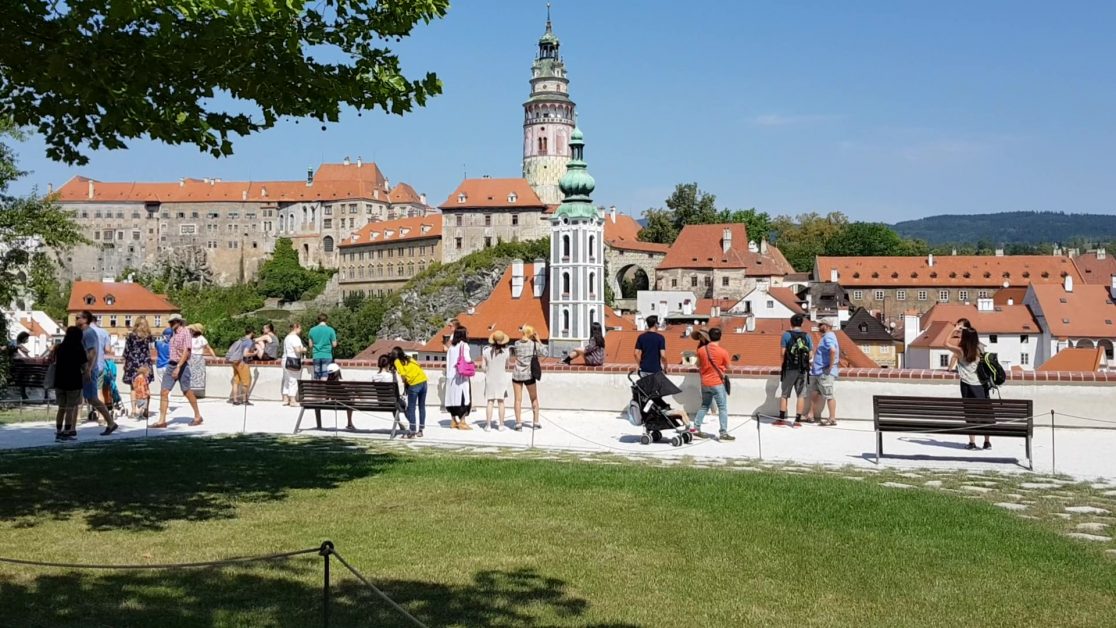
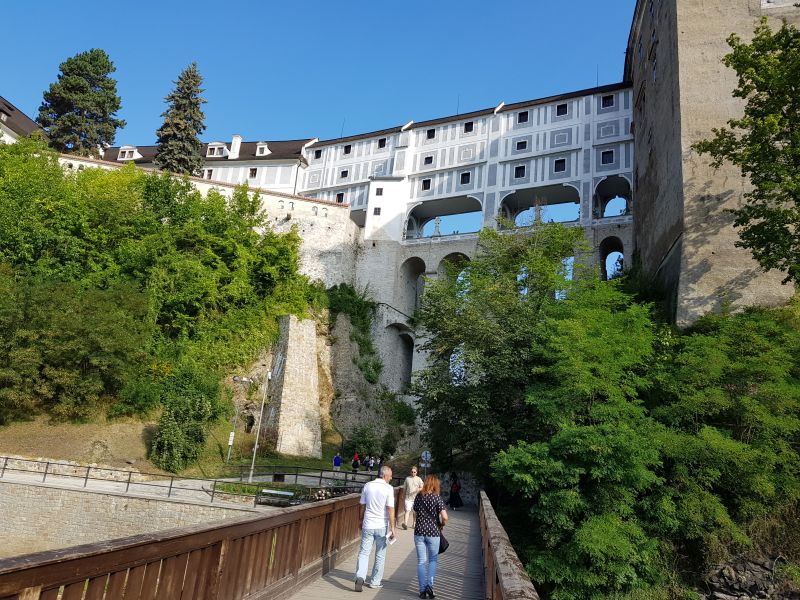
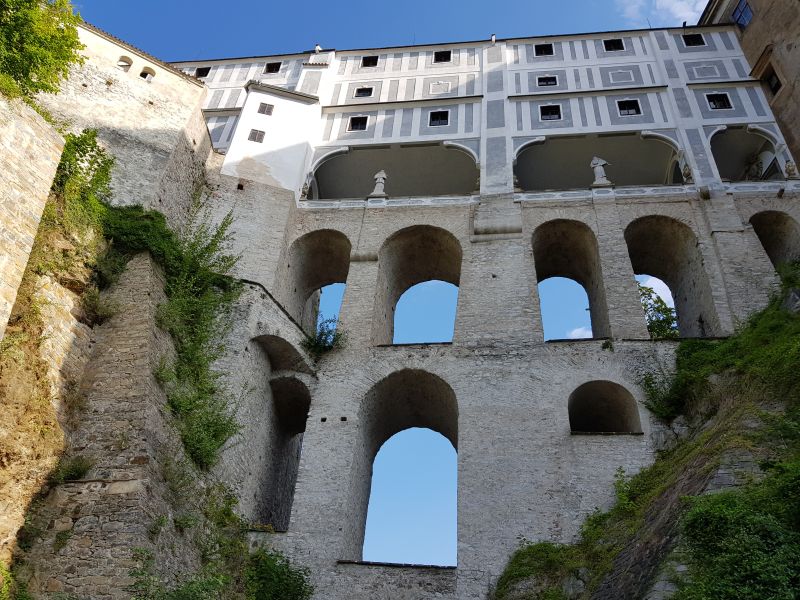
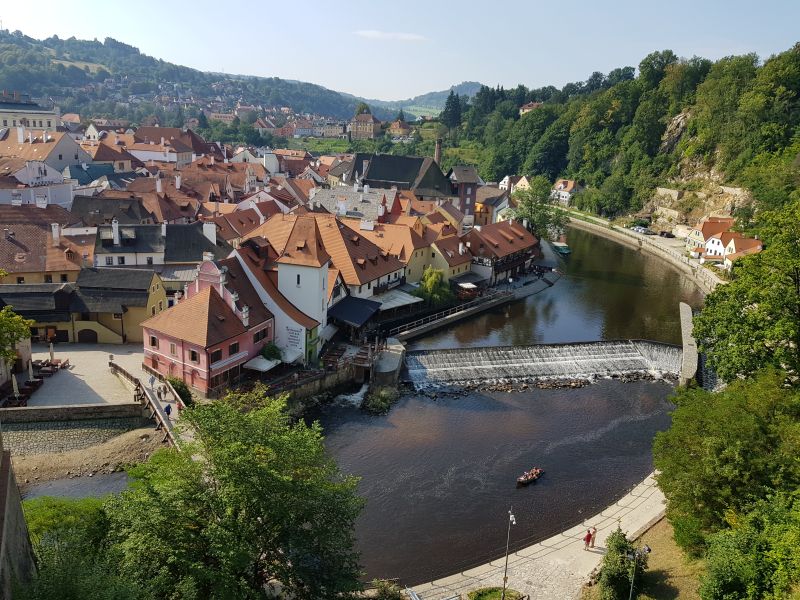
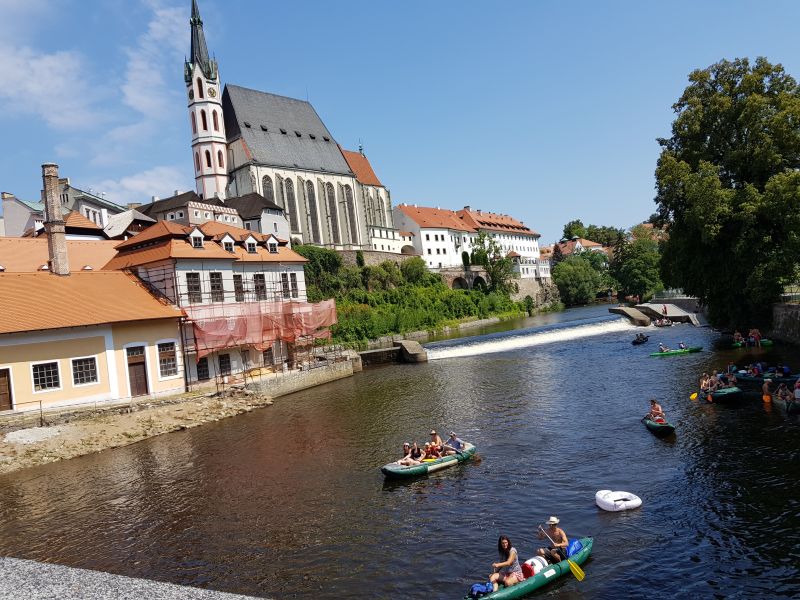
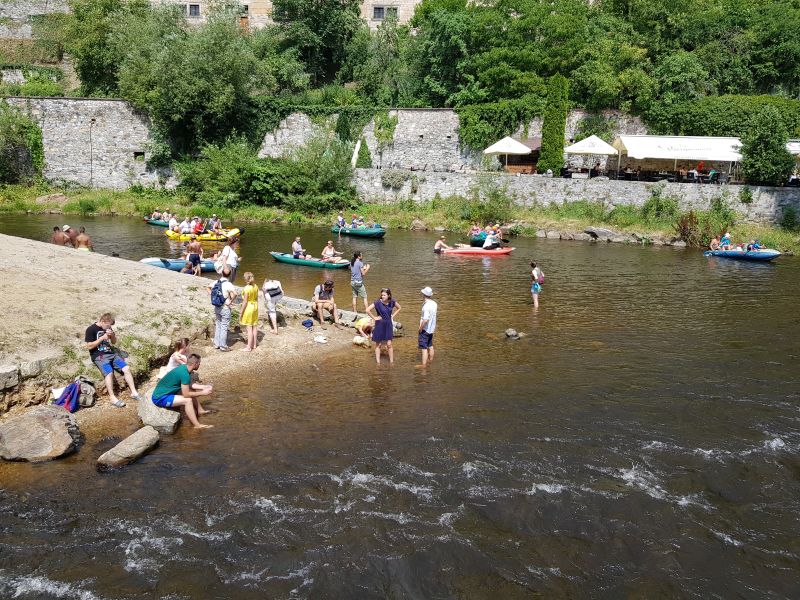
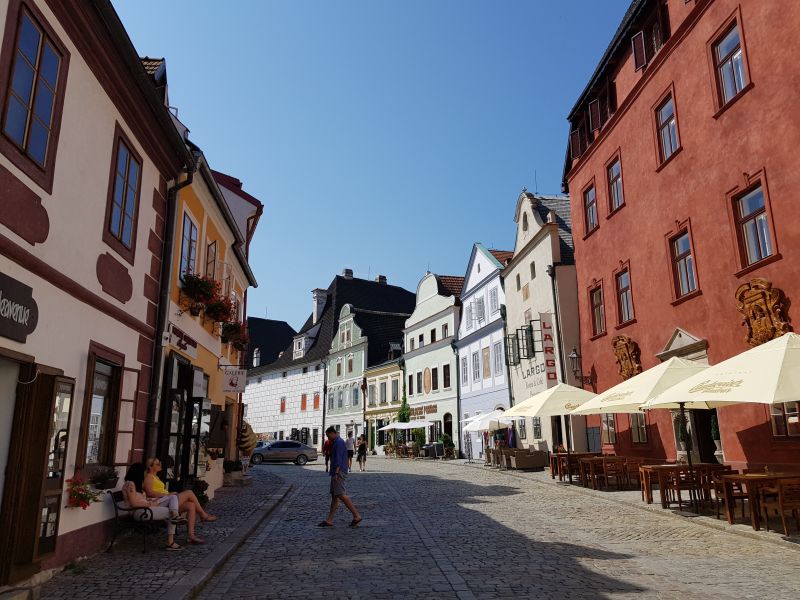
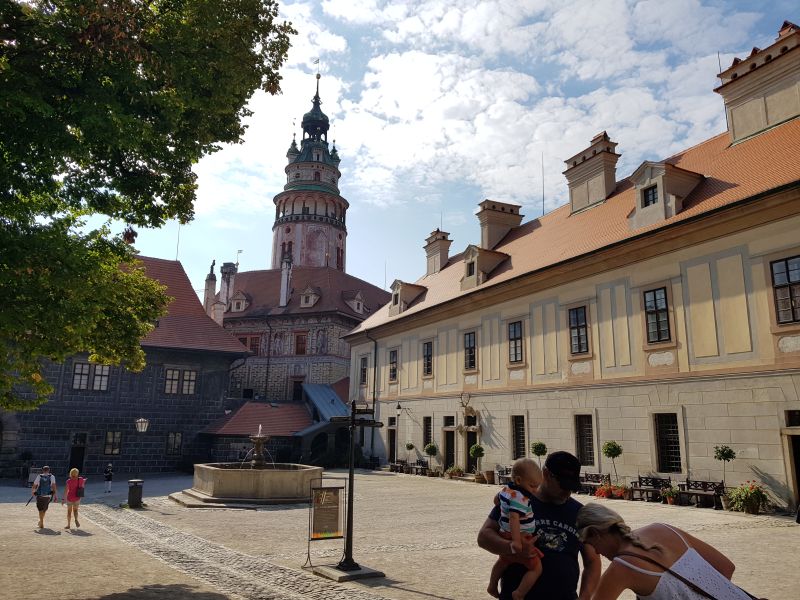
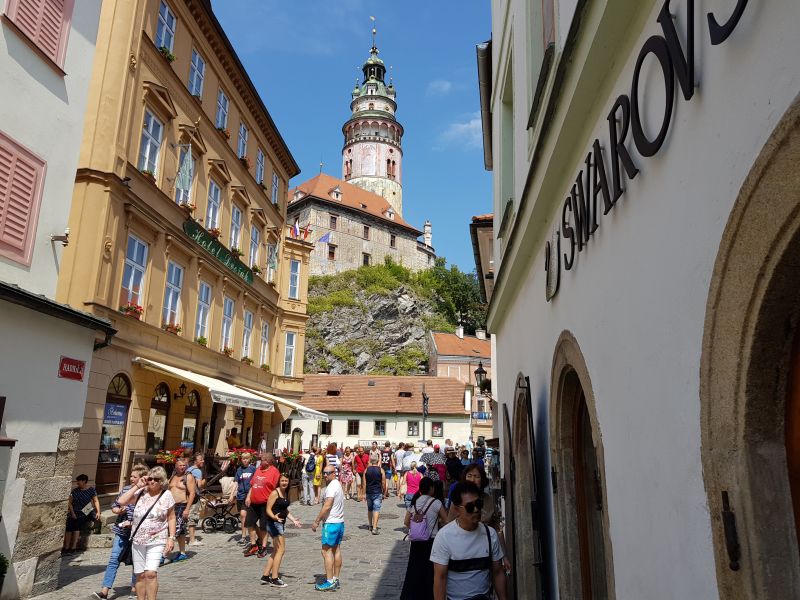
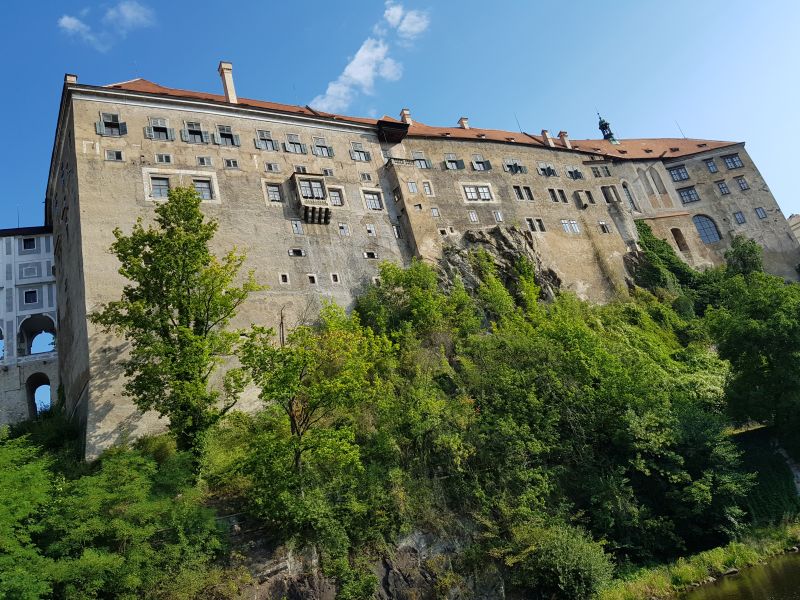
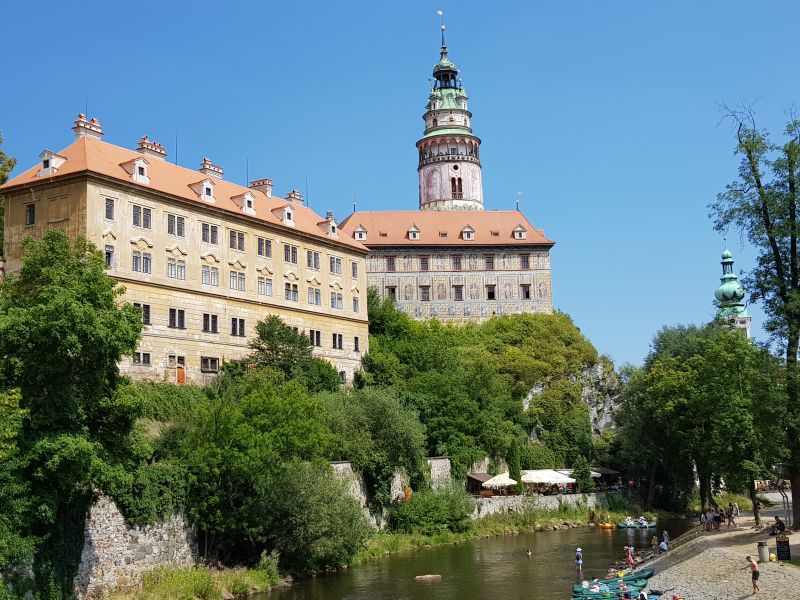
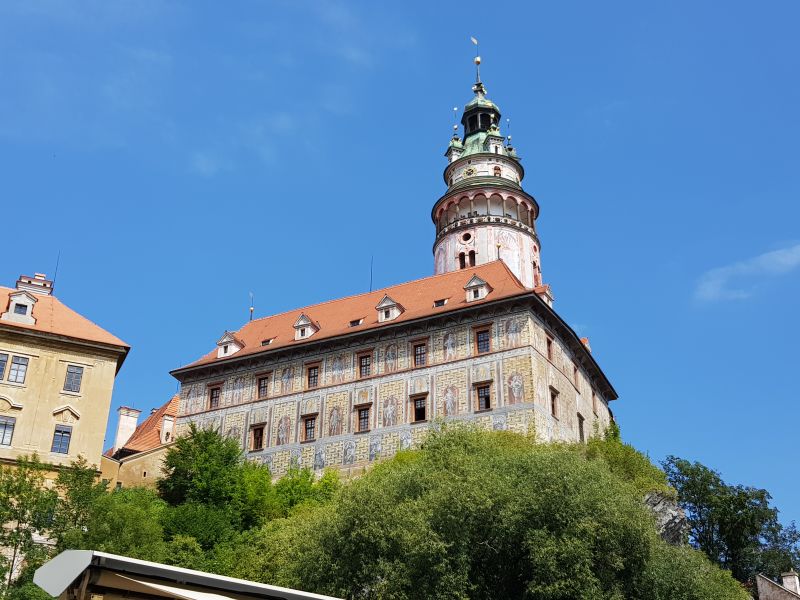
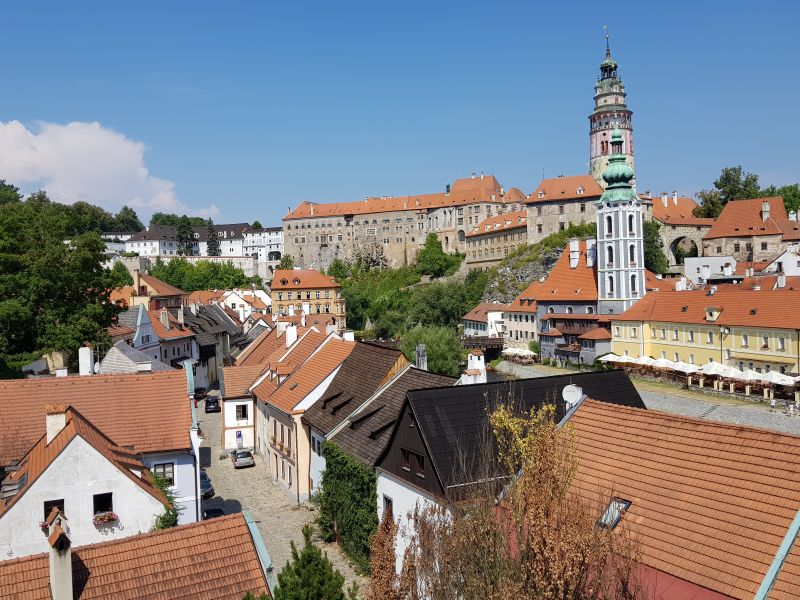
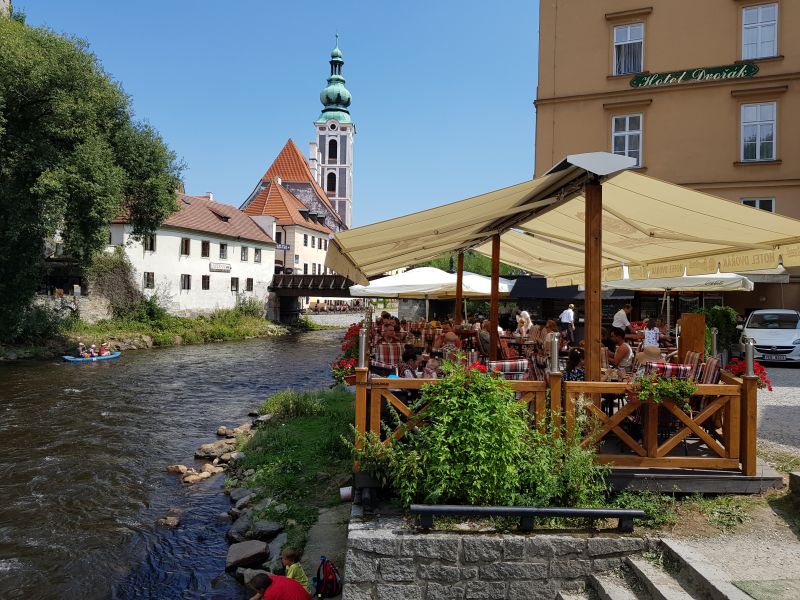
4/8/2018. From Ceske Budejovice, I took an early bus, and after 40 minutes, I arrived in Ceske Krumlov. This was a little beauty with a big reputation, tucked away, coy, and perhaps scared, withdrawn into her own little world, seeking seclusion and protection—yet second to none but Prague. A tall wall confronted me at the entrance gate, her first line of defense. High rock faces backed her up, a stream meandering around her like a moat.
This was indeed another hot day. Throngs of Koreans, then Japanese, then mainland Chinese, all converged on the little town. We may not get along famously back home, but we sure look like one big family here, wandering in wonder. To my surprise, in this little old historical town, I came across two Chinese restaurants, both prominently located. One was a self-proclaimed Beijing Restaurant, the other was called Shanghai Restaurant. I hoped they wouldn’t add a few more here, or we would soon have a China Town here, which would be tragically out of character. For today, this was a dreamed fairy-tale visit. I did not wish to stir from it.
4/8/2018 一大早上大巴到四十分钟外的克鲁姆洛夫 (Cesky Krumlov)去。皮尔森小有名气,克鲁姆洛夫则名气不小,仅次于布拉格。城墙给她保护,峭石为她看哨,小溪绕着她身边流淌。好像畏惧外界,时刻寻求保护,看来与世隔绝,与世无争的小世界。
大热天气, 加上洪亮嗓子, 今天场面火热。一回一帮韩国人,又一回日本人,中国人,今天基本都是亚洲面孔,亚洲声音,亚洲的气势,亚洲人的钱,在自己家园我们大家还闹着呢,在这里大家凑起来热闹了!我们都在花钱看别人的戏,也没错,只要不是我们自己没戏了。
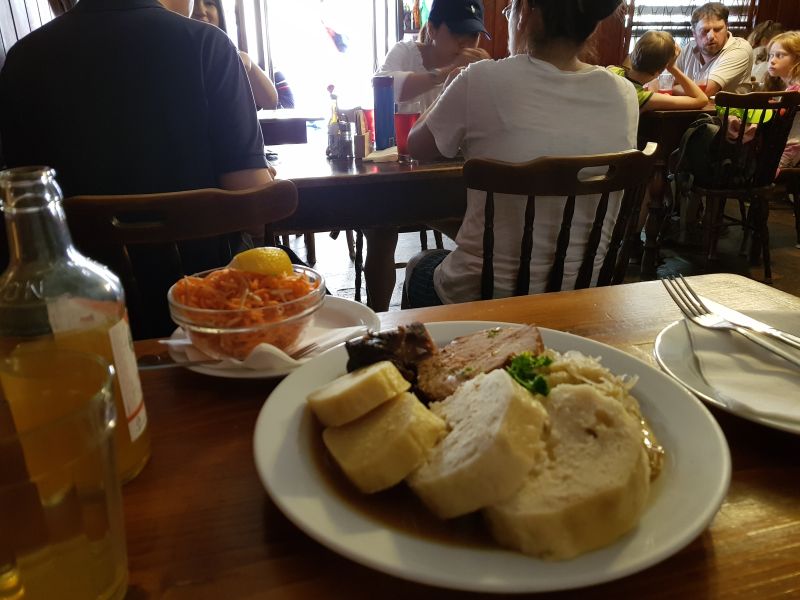
在这克鲁姆洛夫 (Cesky Krumlov) 走了好几小时, 见到两家中餐厅, 名字有创意, 无余流露思乡苦 – 一个高调为北京饭店, 一个嚷叫为上海饭店。不知谁先开, 谁应对联,好像有点帮派火药味, 难到一家取名北京鸭, 另一家就非得回敬上海鸡不可? 很意外小洋村内见到两家中餐厅。两家够了, 再变成三家四家很快这古镇就有条唐人街,那就格格不入了。我还是做能曲能伸的人,中晚餐都吃捷克菜。
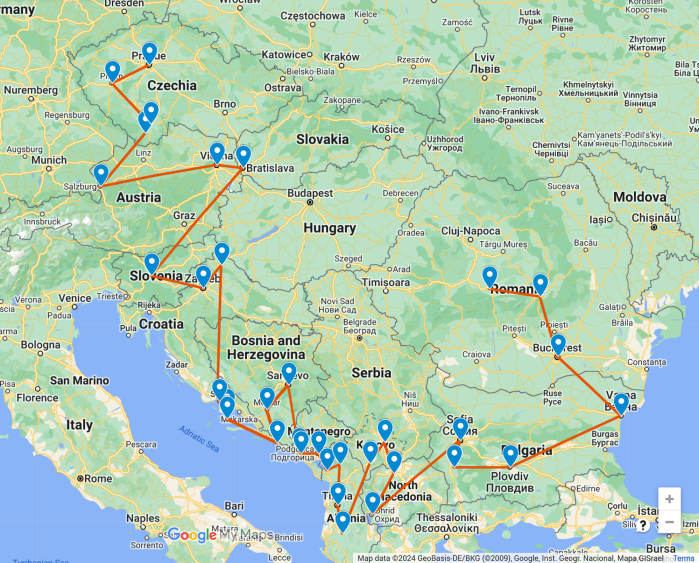
The stops on this trip:
- Prague (Czech)
- Pilsen
- Cesky Budejovice
- Cesky Krumlov
- Salzburg (Austria)
- Vienna
- Bratislava (Slovakia)
- Ljubljana (Slovenia)
- Zagreb (Croatia)
- Plitvice
- Split
- Brac
- Hvar
- Budrovnik
- Mostar (Bosnia and Herzegovina)
- Sarajevo
- Kotor (Montenegro)
- Perast
- Podgorica
- Shkoder (Albania)
- Komani Lake
- Tirana
- Berat
- Prizren (Kosovo)
- Pristina
- Skopje (North Macedonia)
- Ohrid
- Sofia (Bulgaria)
- Rila
- Plovdiv
- Varna
- Bucharest (Romania)
- Brasov
- Sibiu
Slot game tại 188v nhà cái được phát triển bởi các nhà cung cấp hàng đầu thế giới như Pragmatic Play, Microgaming, NetEnt – chất lượng không cần bàn cãi. TONY05-08
Natural writing depends on more than grammatical correctness: pacing, sentence variety, transitions, and a consistent voice all shape how a passage feels. A tool designed to create texto más natural can be useful when an AI-assisted draft sounds repetitive or overly formal. Multilingual support for Spanish, Portuguese, English, and Japanese broadens that editing use case, particularly when the writer wants to preserve meaning while improving flow. The revised copy should still receive a human check for names, dates, cultural nuance, factual accuracy, and any distinctive wording that gives the piece its personality.
Travel itineraries often become bulky PDFs once maps, booking confirmations, scanned documents, and attraction notes are combined. The ability to reducir tamaño de PDF can make an itinerary easier to store offline, email, or open on a phone with limited connectivity. Browser-based processing also avoids sending the document to a server, which is relevant when it contains reservation details. After compression, travelers should verify that map labels, confirmation numbers, and QR codes remain clear, while retaining the original as a backup.
Editing Spanish content becomes more informative when counting is paired with qualitative signals. A contador de caracteres can clarify whether a draft fits a platform limit, while sentence length, readability, keyword frequency, and rhythm reveal how comfortably it may be read. Seeing those measures update during revision helps writers shorten crowded passages and balance repeated terms before publishing. This is useful across blog posts, descriptions, academic assignments, and social copy, where both space and clarity matter.
Hiring teams can lose useful interview time when they rely on the same broad questions for every applicant. RoleProbe creates a more specific starting point by analyzing the job description alongside the candidate’s resume, then suggesting targeted questions, answer signals, and evidence requests. That structure can reveal where a candidate’s experience directly fits the role, where clarification is needed, and which claims deserve deeper examination. The strongest use would be as an interviewer’s preparation aid rather than an automatic decision maker, since relevant experience can be described differently across industries, employers, and career paths.
Patchwork Tattoos can be most useful during the early comparison stage, when someone has several motifs but has not settled on their scale, spacing, or visual balance. Generating a few variations makes it easier to identify which elements belong together and which create unnecessary clutter. A strong reference should also show the intended body area and leave room for an artist to adjust flow, line detail, and longevity rather than treating an AI image as a finished stencil.
HR decisions become easier when guidance separates universal operating principles from rules that vary by location. Folio HR offers plain-English material on hiring, payroll, employee performance, compliance, and workplace technology for small and midsize teams. A strong resource structure would let readers begin with a short overview, move into a practical checklist, and then review jurisdiction-specific cautions. Including ownership, timing, required records, and common failure points in every guide would make the information more useful for managers who need to turn policy into a repeatable process.
For a simple audio utility, the most helpful design is one that explains the process before the user commits to it. It should state that only permitted links belong in the form, identify the resulting file type, and give a clear indication of whether conversion is in progress or finished. An audio converter can stay lightweight while still offering useful feedback, such as a readable error for an unsupported link and an unmistakable download action once the file is ready. That balance makes the process easier to follow.
Rewriting an AI-assisted draft should involve more than replacing words with synonyms. An effective AI article rewriter needs to improve paragraph order, transitions, sentence rhythm, and clarity while preserving the writer’s intended meaning. That distinction matters for travel writers, creators, and marketing teams whose content depends on a recognizable voice. The strongest workflow combines structural revision with manual review, allowing awkward phrasing, unsupported claims, and inconsistent tone to be corrected before an article is published.
Japanese writing often needs more than a basic character total. A 文字数カウンター can show characters, lines, and paragraphs while also converting the text into an estimate of 400-character manuscript pages. Displaying both UTF-8 and Shift_JIS byte counts is especially useful when a publishing form or older system imposes a technical size limit. Real-time updates also make editing easier because every deletion or revision is reflected immediately. Processing the text locally in the browser adds a meaningful privacy benefit for unpublished drafts, application materials, or other content that should not be uploaded merely to measure its length.
Travel records, tickets, itineraries, and archived guides are easier to organize when their text can be searched and edited in a consistent format. A browser-based way to convert pdf to markdown can turn text documents and clear English scans into structured notes without requiring registration or sending the files to an application server. The resulting headings and lists can fit naturally into a research notebook. Maps, multi-column brochures, stylized typography, and poor scans may need manual correction, so reviewing the output remains an important final step.
The strongest content plans usually begin by asking whether a query genuinely belongs on the site, not simply whether it attracts searches. A structured keyword discovery process can compare topic relevance, audience intent, and the site’s existing coverage before drafting begins. Once a suitable topic is selected, turning it into an editable draft creates room for factual checks, stronger examples, and a consistent voice. Approval before publication then keeps automation useful without handing it the final editorial decision.
Invisible characters are easy to misunderstand because an empty-looking field may contain a normal space, a line break, or a Unicode code point. A practical tool should make that distinction visible before anything is copied. Invisible Text addresses a straightforward need: choosing a character, generating the required length, and checking the output in the browser. Clear labels for character type and copy behavior would help people use it for formatting or testing without assuming that every website will treat the result identically.
For anyone learning signals, it helps to separate decoding from memorising. Start by translating a short word, compare the dots and dashes with an alphabet reference, then listen to the rhythm before trying a longer phrase. A Morse Code Translator with both directions available makes that small practice loop much easier: write, inspect, hear, and correct. Downloadable text or audio can also turn a quick exercise into material for offline study.
[2513]777taya Online Casino Philippines: Login, Register & APK Download,Experience the best gaming at 777taya Online Casino Philippines! Secure login, easy registration, and APK download available. Join 777taya today and win big! visit: 777taya
Music discovery is not always about finding a currently playing recording. Sometimes the starting point is a tune recalled from a film, a shop, or an old playlist. music recognition tools that accept a user-created hum or whistle address that gap well, because they turn a memory into searchable audio. Clear guidance on recording a quiet, distinct melody would make these tools even easier for newcomers to use.
Study materials are more actionable when students can find the right document for a specific subject and semester without sorting through unrelated files. SRMIST notes can support focused revision when used with the course syllabus and recent class instructions. A useful routine is to list the topics, mark unclear concepts, then pair each topic with notes and practice questions rather than trying to review everything at once.
[807]qqnusa: Login Daftar Slot Gacor Dana Tanpa Potongan,qqnusa menyediakan akses login mudah dan daftar qqnusa APK untuk main baccarat online. Nikmati situs judi depo pulsa yang praktis. Gabung sekarang juga! visit: qqnusa
Summer activities are easier to reuse when a printable set includes both open, simple designs and scenes with enough detail for longer quiet time. Summer Coloring Book Pages can be arranged around beach days, gardens, travel, or favorite summer foods, giving a group several directions without needing extra supplies. Leaving space for names or dates also turns finished pages into a low-pressure seasonal keepsake.
https://forum.krn.pl/forum/viewtopic.php?f=98&t=40763&p=68935#p68935